A SCIENCE FICTION STORY
1
A slender, agile, dark-haired woman with lively brown eyes, quickly approached the glass folding door separating the veranda from the room, and looked at the man lying on the covered with linen couch.
“It looks like he is sleeping. What do you think, Alexey Eliseevich?”
Kruchenykh on tiptoe went to the partition and made sure that Malevich was snoring peacefully, drowning in a soft pillow tucked into a white lace pillowcase. There was so much white on the bed that it made the sleeping man’s face look anemic.
“Let’s go into the living room, I’ll make some fresh tea. Or, maybe you want to eat?”
“Don’t worry, Natalya Andreevna. Tea is enough. I’ll wait until Kazimir Severinovich wakes up.”
They returned to the large room, which served both as a living and a dining room, where fourteen-year-old Una, the artist’s daughter, was already arranging dishes for breakfast.
“As soon as I learned that you came for the summer, I decided to go to Nemchinovka. To visit you and to chat about business.”
Natasha was surprised, although she didn’t show it. What business? Kazimir is getting worse, he is not permitted to go to Paris for treatment, he was fired from his job, an emptiness is gradually forming around … But the visit of an old friend was a pleasure.
“What do they say in the capital?” She asked the guest, pouring tea into cups.
“They mostly keep quiet. They read “Pravda” about our successes and rejoice it.”
Natasha nodded in agreement.
“The political struggle is escalating!” shouted slogans.
“Although why would it?” she thought and could not comprehend it.
But, worst of all, the slogan is used to settle scores with opponents and competitors. One nasty word, and the person is dragged for interrogation. It’s good that someone is released like Kazy. And they eat each other! Menzhinsky replaced Peters, Yagoda replaced Menzhinsky. Who will be the next one replacing Yagoda?
She politely smiled and said, “Everything is quiet here… Mushrooms… The only our trouble is that Kazimir Severinovich suddenly fell ill.”
Kruchenykh sighed in understanding. Sad news had already reached him. Recently, he made money only by selling rarity books to wealthy people. And they were well informed.
“They say Malevich is terminally ill? Is this true?” asked him one of his client, assistant to the People’s Commissar for Foreign Affairs Litvinov.
“I don’t think so. I will visit him soon and find out.”
“In that case, ask him if he wants to sell one or two of paintings to an American museum. There is a reliable transfer channel, and it would be a great help to his family.”
Kruchenykh did not even dare to say, “Yes”. He chuckled evasively and bowed in good buy. He just had enough and he didn’t want to get into additional trouble. But, rumors about cancer got confirmed, it was difficult for the artist to paint because of weakness, and his teaching was taken away. Alexey couldn’t left himself aside and not to help Kazimir.
“How’s it going, Una?” he asked, trying to get away from disturbing topics even in his thoughts.
“Better and happier!” answered Una with a pioneer passion. “But daddy got sick”, she added, feeling sad. “I’ll paint you “Happiness”, he says. “I believe him”.
“Believe him, believe,” Alexey confirmed. “He is such a guy. He will do exactly as he said, right, Natasha?”
“Yes, exactly. I’m so calm with him. I feel like I am behind stone walls.”
“That’s good,” said Kruchenykh.
“In our time, there are not stone walls, but barbed wire,” he thought, and sipped his tea.
At this time, a quiet grunt and the voice of Kazimir came from the veranda:
– Are you there Natashen’ka? Is someone visiting us?
Ten minutes later, Natasha transferred the poet into a chair next to her husband’s couch. Kazimir spent his days on a spacious veranda, with plenty of air, light and space. There were chairs and an armchair for guests, pictures of Malevich in frames, and the suprematist china set, created at the Lomonosov porcelain factory according to the artist’s sketches, adorned the tea table.
The guest and the host talked about this and that, about the “unpopularity” of avant-garde in the USSR.
“And what can I do if some comrades perceive even my “objectless half-images” of peasants as a hint of kulaks and sabotage. And remember, how well we established the new revolutionary art in Vitebsk, in UNOVIS!”
“Yes, I remember. You even named Una after it. Chagall was right that he did not return from the exhibition. Have you thought about such a step?”
“No. Mark was lucky; he received a permission to go abroad with his family. And I had everything left here: family, children, students. Home attracted me more strongly than the West. Of course, there was honor, respect, but where is to find such a Nemchinovka there? And Natasha? And Una? Tell me better, how are you?”
“Oh, there is nothing to tell about. They understood that my super smart futuristic language is a hint of a code for spies. Which Sun do you want to defeat in your opera?” they asked me. “As a result – I don’t work … I barely make living by selling books … and …” suddenly, as if making up his mind, Kruchenykh rushed off the bat, switching to a whisper, “There is a buyer for a couple of your paintings for the Museum of Modern Art in America. He will pay well. It’s a good help for the family.”
Malevich paused, smoothing his beard.
“It maybe makes sense,” he said. But while I am alive, I myself will take care of the family, but after … well, I will talk to Natasha, give her instructions. Go to her with the money, then … well, you understand when. Otherwise looks like I promised my loved ones happiness, but prepared grief.”
“What are you talking about Kazimir? Nowadays medicine creates wonders. It’s simply weakness, the brush is trembling in your hand, so wouldn’t it be better to sell some of the old work. Heal, get stronger – recreate them anew. I suppose you painted not just one square, ah?”
“I’ll heal, right! Our doctors don’t know a damn thing; however, authorities don’t let me go to Paris for a treatment. What’s the use of my painting? Some are kept in Russian storerooms, others – in German hiding places.”
“That’s why America is a good choice. At least they won’t hide pictures there. Everything will be put on display.”
“No. As I said, not now. Only after my death.”
“And what painting do you agree to sell?”
“And what is required: a new painting or an old one?”
“The old is better. Classic Malevich. Are there no squares left?”
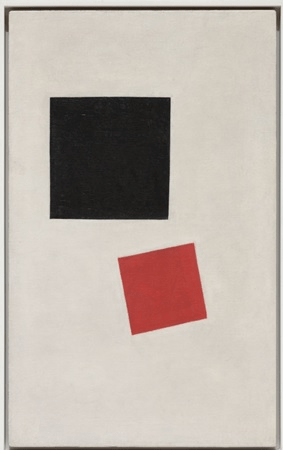
“There is “Boy with a knapsack, 1915.”
“Great! That is – “Black Square and Red Square”. Pure Suprematism! I’ve always loved it.”
“Then, consider that we agreed. Natasha will tell you the price then. It’s not right time yet.”
2
When Kruchenykh left, Una made her way onto the veranda to her father and curled up in an armchair near his sofa.
“Did Uncle Alexey upset you dad? Do not be sad, you will get better! Everything will be fine.”
“What are you talking about, my dear? Uncle Alexey, on the contrary, made me happy. May be I’ll work and paint you happiness. I must! And let us enjoy the picture. Can you find the painting “Black Square and Red Square”? Yes, yes this one! Put it on a chair – let’s look at it. I painted it almost twenty years ago. I looked at a schoolboy in a red confederate cap and with a black leather knapsack behind his back and saw, as it were from above, that two squares were moving together on the surface. Well, like a look from another dimension to the plane.”
“Why a confederate cap?” asked curious Una not paying attention to another dimension.
“Students from the Polish gymnasia wore such square caps. Well, really, doesn’t it look like a schoolboy with a knapsack on his back?”
“Not really…”
“And you imagine that these squares are bird’s point of view of a red cap and a black knapsack from the above.”
“If this is a bird’s point of view, than it looks very much like a cap and a knapsack…”
“Okay, Una, go better read a book. And I will enjoy it a little longer.
Una kissed her father on his unshaven cheek and rode off to her summer vacation business, while Kazimir continued to look at the canvas.
In fact, he was not going to rest. He wanted to think about something. In 1930, at an exhibition of his works in Vienna, the young doctor of mathematics Gödel joked, “The consistency of Suprematism cannot be proved by the means of Suprematism itself.”
Malevich always knew this. He looked at his canvases with a gaze from another world. The painting was a kind of bird’s view only for Una, but the artist imagined what the macrocosm, or the Universe, sees looking from the fourth dimension at the microcosm, that is, at a person. And a human being, even the greatest mathematical genius like Gödel, is just a kid, a student with books in his knapsack, wandering around the world, accessible to the eye of the Universal Mind. And for him, a helpless sick student Kazimir Malevich, left only one option – to beg the Teacher for happiness for his family and his beloved daughter. After all, if his days are numbered, and there is no strength in his hand to draw Una happiness, then all that remains is to order it from the Universe. Maybe it will stretch out its helping hand to the artist and fulfill his promise to Una.
Dragging covered Kazimir’s eyes, wandering around the squares on the canvas; a clouded mind caught the artist and carried him to unknown places of space and non-objective art:
“The airplane like dragon flies,
And voices roar: “Hurray and Hail!”
Black Square – Red Square are our lies,
Then go above those squares and aisles.”
It seemed to him that the black and red squares spun in front of his eyes like the propellers of an airplane, he took off and now he is falling down. Bang! What’s ringing?
He actually fell down. From the couch? It’s good that it was not too high – he didn’t hit hard, but what means this disturbing ring?
Kazimir cautiously opened his eyes and immediately closed them. Around him was not the veranda of their house in Nemchinovka, but a huge, light-flooded hall with paintings on the walls. A young man in a red cap and with a black leather backpack on his back was dragging him by the sleeve of his pajamas across waxed parquet, from the wall on which, in a wonderful group of cubist and abstract paintings, hung his work “Black Square and Red Square” of 1915 year.
The young man leaned over to Malevich and asked in English,
“Is everything OK? Do you need any help?”
“Where am I? Matka Boska! I do not speak English.”
“But you do speak Russian. And me too.”
“Who are you? Where am I? What was ringing?”
“Don’t worry, sir. Get up, I’ll help you. I am a geology student, my last name is Riemann, and my name is Basil or Vasily. This is MoMA – Museum of Modern Art, and the ringing sound was an alarm. You fell directly under the painting, in the laser-controlled area. And here is the guard.”
An elderly black woman in a blue uniform with silver patches of museum attendant hurried to them. She carefully looked around the hall and its rare visitors, hold her gaze on the strange man in pajamas, but found nothing suspicious and left, grumbling displeased under her nose, “Everything is intact and in place, there is no one close to the picture, only the man looks like this crazy Salvador Dali in the room. How is he dressed? In my time, people went to bed in this outfit, but now they walk around the city, visit museums. Ugh! But, no surprise, one glance at the walls – and it is clear that you are in a madhouse! No wonder Molly thinks that I am becoming … a little bit cuckoo too”.
Dumbfounded Kazimir obeyed his unexpected defender, who carefully tried to take him out of the hall. But the more the artist’s consciousness cleared up, the more he resisted this boy … what’s his name … Vasya.
“This is me, this is Braque, this is Picasso, this is Mondrian, this is Kandinsky,” Malevich commented, pointing to the paintings. “Vasya, I ask you, please, explain me carefully, where exactly are we? Why do they speak English around and why are they staring at me?”
“All right. What’s your name?”
“Kazimir Severinovich.”
“ Malevich’s namesake?”
“Why namesake? I am Malevich, but I don’t understand how I got here.”
Vasya looked with all his eyes at the disheveled, bearded, mustached man, in pajamas and walking barefoot around the museum. Undoubtedly, this is a sick, homeless beggar, who sleeps on the sidewalk and feeds on alms. “Strange, but it doesn’t smell at all. How did he get inside the museum? We should first calm him down.”
“You are in New York, USA.”
“A!” the man in pajamas exclaimed.
“This is the Museum of Modern Art, the hall of cubism and abstract art.”
“It’s impossible!”
“And they stare at you because you are in pajamas.”
“Jesus Maria! In pajamas, in a museum? What a disgrace! Help me, I beg you. I’ll tell you everything, I must necessarily get back to my family.”
They moved to the escalator on the first floor. On the way, Malevich kept stopping and admiring the paintings and sculptures?
“Impressionists! Matisse! Mark Chagall! Oh! And who is Dali?”
His face turned pink, and his soul felt so good, as could be only in childhood, when you receive an unexpected wonderful gift on your birthday.
3
Initially, Vasya was going to move away from a strange man who called himself Malevich and escape on the sly. After all, why should he personally be concerned with this homeless and mentally ill person?
Perhaps, he would have done so if … he had a family. However, unlike most of his peers, Vasya lost both parents, and recently his aunt who raised him. And he was well aware of how a lonely person felt, especially in unfamiliar surroundings, and that even quite friendly New Yorkers were unlikely to want to communicate with an excited barefoot foreigner in pajamas who spoke neither English nor Spanish.
And Vasya decided to sort out the situation at a table in a cafe, where they will have a snack, which perhaps will calm the guest.
“Did you have dinner?” Vasya asked the stranger.
“No, I have not had breakfast yet. Natasha called and said, “The table is set!” but I decided to look at the picture first.
“To go to the museum?”
“No, are you kidding? What museum? My own painting “Black square and red square.”
“Yes, you fell in the museum hall exactly next to it.”
“But I looked at it at my place in Nemchinovka.”
“Do you live there? With Natasha? Excuse me, but who is she?”
“With my wife, Natalya Alekseevna Manchenko, and our daughter, Una Kazimirovna Malevich, we usually spend summer vacations at our dacha in Nemchinovka near Moscow, while we are registered in Leningrad.
“So, you have a family and you live in St. Petersburg?”
“Young man, you surprise me. Our city has been named after the leader of the revolution for ten years already, and you don’t even call it Petrograd, but St. Petersburg.”
“Excuse me Kazimir Severinovich it’s you surprising me. Leningrad has been returned its original name St. Petersburg for almost thirty years. Before I was born.”
Malevich’s lips trembled, his eyes moistened. He sighed convulsively and asked with a sinking voice, “What year is it now?”
“Two thousand nineteen,” Vasya answered and immediately grabbed the staggering stranger by the elbow, “Let’s sit down, have a snack, drink tea, coffee.”
They sat down to a table in the cafe of the Museum of Modern Art, away from the exit to the inner garden filled with sculptures. Vasya already knew that works of art strongly affect his new acquaintance, but it seems that even the simplest information about life affects him in the same way.
However, to the surprise of the student, the guest turned out to have a strong character. After drinking tea and thinking, he expressed a logical, albeit delusional thought, “I am beginning to comprehend something … I was somehow transported from the past to the future. I “entered”, but please do not ask how – I myself do not know – into my painting “Black Square and Red Square” at my dacha in Nemchinovka in the summer of 1934, and I fell out of it, but already in New York in museum in 2019. Moreover, I know why! Because after my death, the painting was sold to the museum. How to find out when I died?”
“Why do you need this?” Vasya asked, opening the search in the iPhone under the table, “Live longer!”
“I’m afraid my days are numbered,” Malevich frowned, “Every day, I feel worse, but the doctors say, “These are usual age-related changes. Everything will be alright.” They don’t know a damn thing at home, but they don’t let me go to Paris for treatment.”
Vasya was more and more imbued with confidence in the story of the stranger. He could not imagine why a swindler, who plays the role of Malevich with amazing naturalness, would need to get into the confidence of a lonely student. He has already looked out on the Internet for the date of the artist’s death and its cause – prostate cancer, but most importantly, he made sure that a living person in front of him is like two drops of water similar to a photograph of a sick artist Malevich.
“You know, Kazimir Severinovich, I am not a doctor, but my parents are from Russia, and I know that doctors there hid bad diagnoses from patients, but here they do not. I think that the doctors knew everything, but spared your nerves.”
“You think so?” Malevich pondered, “You look reasonable beyond your years. What advice would you give me in my situation?”
“Honestly? I see two options: try to return home the way you got here, or … stay here. In our time, you can be greatly helped in the treatment of illness.”
“But does not that mean … leaving your family? I cannot do that. In the twenty-seventh, I was offered to stay in Germany, but I refused for the same reason. People change little over the years if they are honest with themselves.”
“Then the only one thing remains – to go to the picture and try to return home. But, we must hurry, the museum will close soon. Just stop! I have sports shoes and a windbreaker in my backpack. Try it on.”
4
Basil was thinking feverishly. On the one hand, he believed with all his soul of a romantic young man in Malevich’s fantastic story. On the other hand, what if nothing happens with the transition? After all, if this is a deception or a joke, then, of course, zero will come out of the “return”. And the stranger will ask to spend the night with him, and … what? Will he rob, kill? What if he is yet crazy or a swindler? However, refuse, drive him out into the street seemed to Basil somehow shameful and not humanly.
Therefore, he decided to seek help from his neighbor on the floor – a urology resident. They often played tennis at the local court. Maybe the neighbor will just take a friendly look at the “poor relative from Russia” and assess whether he is sick? The swindler will definitely refuse to meet with a specialist doctor, especially since Vasya will have to be a translator and be aware of all his secrets.
Inspired by the idea, Basil dialed his neighbor’s cell phone. Man’s voice answered,
“Hi Basil? How are you? Any problem?”
“Not with me, Bob. One of my relatives came from Russia, and he seems to have advanced problems with his prostate. Would you agree to examine him? Only … he has no insurance or money. Tell me, would it be expensive to pay in cash?”
“Forget it. No problem. Bring him to the university clinic any Tuesday evening like today. We have a free checkup for the poor.”
“Can I bring him right now?”
“Of course you can. Do it quickly. With darkness, we’ll close the office. What is his last name? I’ll put it on today’s list.”
As Basil had anticipated, the “return” has failed. Frustrated Malevich, along with his “guardian angel” left the Museum of Modern Art on the street still lit by the sun.
“Wow!” the guest from the past immediately forgot his sorrows when he saw the skyscrapers of New York, “Where are we heading now?”
“We will see the doctor, since you managed to escape abroad. Here, of course, is not Paris, but they also understand a bit. Carefully cross the streets, we are going across the street, to the subway – the metro, that is.”
“What is a Metro?” asked Malevich, “Metropolitan Railroad? I saw it in Berlin in the twenty-seventh. And we are still only building it in Moscow. Wow, what amazing yellow cars!”
“These are taxi, and there will be a Metro in Moscow and Leningrad! Much more beautiful than ours.”
They crossed 53-rd Street and took the subway. Entering the station through the turnstile and paying with a card again amazed Malevich, he did not like the heat at the station, but the coolness, multi-colored seats and colorful advertisements in the subway car delighted him.
Soon they reached the clinic, where Malevich was already expected. Dr. Robert Murphy, tall and athletic, in a green surgical suit and white coat, met them at the door of the office.
Basil translated … After a while, the doctor took the patient behind the screen for examination. Malevich moaned softly, he clearly was in pain. Then the doctor told the patient to lie on his back and not get up until the ultrasound examination was completed and a blood test was taken. After a while, Malevich returned from behind the screen into the office.
“Ask the patient if he wants to know the exact diagnosis, treatment methods and prognosis or not?”
Basil translated. Malevich nodded furiously in response:
“Of course! I’m not a child!”
“All right,” said Dr. Murphy, “You have stage IV prostate cancer, with metastases to the inguinal and pelvic lymph nodes, to the liver and, judging by the symptoms, to the bones of pelvis. It’s too late to operate. It is meaningless now. As far as I understand, you are returning home soon, so there is no point in starting treatment here. The only thing I would suggest is two options that prolong life: the first is orchiectomy…”
“What is it?” asked Kazimir.
“Testicular amputation.”
Malevich blushed and frowned:
“No way, doctor, I will die a man. What’s the second?”
“Otherwise, you can have an injection of a large dose of antiandrogens.”
“Good. I’m not afraid of injections.”
It got dark. Basil, pleased that the stranger did not lie, but upset with the doctor’s words, and Malevich, exhausted by his incredible adventures, went by taxi to Vasya’s home. Vasya wanted to drive through Times Square and show the guest the luxurious illumination, but he was already asleep, reclining in a comfortable seat. He dreamed of Nemchinovka.
5
The next morning, Basil and his guest were among the first visitors to enter the hospitably open doors of the Museum of Modern Art. Malevich was impatient to start new attempts as soon as possible, they didn’t even have breakfast. The artist no longer looked wild, dressed in a tracksuit, sneakers and a red baseball cap rented from Vasya. However, the sports outfit did not improve health, and Vasya had to support Kazimir by the arm.
All the way to the museum, Basil insisted that the artist think exactly the same way as when he began his experiment at his dacha in Nemchinovka. All the time Kazimir believed that he was not missing anything when he tried to repeat the course of his thoughts in the museum in front of the painting. He even repeated his poetry, but, apparently, he still missed something.
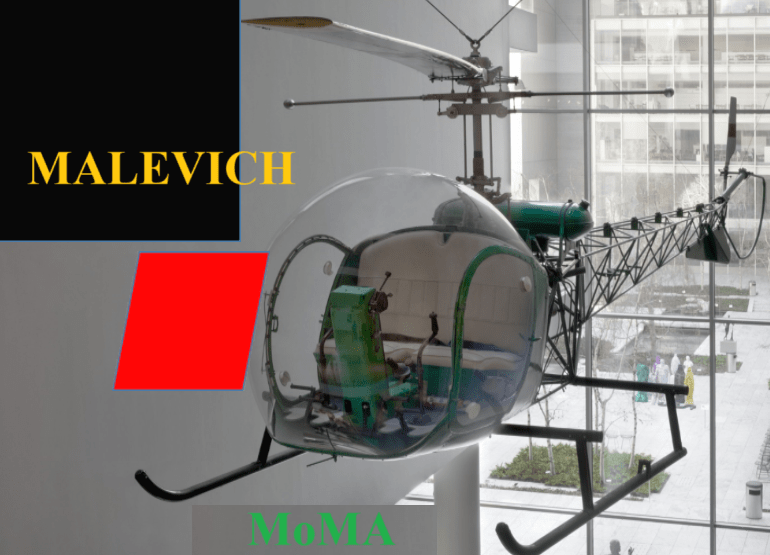
And now, when they were slowly walking towards the hall with the squares, Malevich was struck by a modern helicopter suspended on cables in the span of the floors.
“And what is this dragonfly?” he asked Vasya.
“An aircraft. Its propellers rotate, and it flies.”
At the word “propellers”, something flashed in the artist’s memory. He remembered how he mentally made the colored squares rotate, and then he flew up into the sky.
“Just a second, Vasya, just a second,” he hastened the companion, “It seems that I have remembered what I was missing yesterday.”
Now, with excitement, he was shaken even more, and if not Vasya’s support, the artist would have flown to the floor. They entered the hall as if into a temple: father and son, carefully leading the old man to the miraculous icon of Suprematism.
“Start, Kazimir Severinovich!” Vasya whispered to Malevich, and he fixed his eyes on the picture and quietly whispered his poem.
His eyes clouded over, the squares from his gaze began to rotate again, and his legs gave way. The last thing he felt was the invigorating warmth of Vasya’s hand on his elbow. And – flight. Bang!
Kazimir fell again, but softer than the first time. His eyes opened slowly. He was in a foreign tracksuit, red cap and snickers, lying on his sofa in Nemchinovka, and a young man with a black leather backpack was stretched out next to him.
“Glory to you, Lord!” thought the artist and quietly called, “Vasya, Vasya!”
Vasya opened his eyes, saw a familiar picture with squares on the chair in front of him, and with a gasp he jumped from the sofa to the chair next to him.
“Welcome to Nemchinovka! Now you are my guest!” Malevich greeted him. “We’ll have breakfast now… though wait,” he quickly pushed his sneakers and a red baseball cap under the couch and climbed in a tracksuit under the sheet.
Vasya tried to object, complain, protest, but he only opened and closed his mouth. The right words did not come to his mind. What could he say to this poor, sick old man: “Take me home?” Or to make a claim? Cold sweat broke out on his forehead. “All this is not accidental, I dreamed of visiting my parents’ homeland. So the fate has ordered…“
Suddenly, a sweet little girl of about fourteen interrupted the flow of his thoughts. She ran into the room and flung herself down into a chair, almost on Vasya’s lap. She immediately jumped up and screamed:
“Dad! Do you have a guest? Where from? We did not see anyone enter the house.”
“Don’t shout, Una, meet the guest. This is my friend Vasya Riemann.” Malevich was about to add “an American student”, but he bit his tongue in time. American? Only a spy could be American!
“Bring me some fresh pajamas and tell Natasha to feed us a good breakfast,” he said to his daughter.
An hour later, after they ate the breakfast, the patient returned to take a nap on his sofa. Natasha sent Una for milk to unstick her from the young, came from nowhere guest, and asked,
“It seems to me, or you do speak with an accent, Vasya?”
“No, it does not seem to you. It’s true, I speak English since my childhood.”
“I can’t believe it … How do you survive? Your accent grabs attention, and it may end badly for you at the street. I understand that sick Kazimir Severinovich reveals his dreams as reality, but where did you come from?”
“If you don’t believe your husband that he visited America, then how will you believe me that I am also from there?”
“But he is sick, and you are not. He’s delusional. Are you? Or you just making up stories? Do you have any documents?”
Vasya wanted to answer that yes, he has a driver’s license and a student ID, but he realized that all these American plastic cards better to be kept away from prying eyes foreigners, and best of all – quickly destroy along with credit cards, dollars and his iPhone.
“No,” he said, “I forgot them at home.”
“You see, if they detain you, you will have nothing to show them. Where do you live? Do you have a registration? Do not try to tell them our address – Malevich will be arrested right away. They tried to accuse him of espionage before.”
“Don’t worry, I will not reveal where I stayed. I will not constrain you for long. I’ll work with the painting for a few days and disappear.”
So they decided.
Every day Vasya stared at the squares for hours. He tried to put the picture in different rooms. Una, with the permission of her father, carried the picture for Vasya wherever possible and looked dreamily at him, plunging into a trance. Nothing happened, and Vasya decided to be a man: he put on his black leather backpack, left the house and went to meet his fate. In vain, Una ran after him, and asked to return,
“Don’t go away, Vasya! We all love you!”
He knew it was true. And he understood who these “all” were. For several days now, he felt that he had a family. But after reading the newspapers, Vasya did not just believe, but in his gut felt the danger he posed to these nice people.
“I know, I love you all too. Kazy, Natasha, and … you, Una. I’ll leave for a while, and then I’ll come back. Take care of your family. This is the main thing.”
Ha had only one choice left. The choice he had chosen. His own way.
6
It was cool in the office of the NKVD investigator. After a humid and hot cell, being here was a rest. Senior Lieutenant Semyonov summoned for interrogation a young man of about twenty, who was arrested during an inadvertent document check at the train station.
“Do you understand, Riemann, that you are not a legal human being without documents? Why should I believe your words and not the facts?”
“I am telling the truth.”
“This is your only argument. Unconvincing. An honest Soviet citizen has documents, a passport, a residence permit, parents and friends, classmates, ill-wishers at worst. And you have nobody and nothing. I consider you a spy sent from abroad. This immediately explains all the oddities. How do you explain them? I know you already said that you were visiting friends and, returning home, suffered a head injury that caused memory loss. Come up with something new. The doctor found no trace of this injury. But, your duffel bag made of black leather and your things in it are all imported. Not hiding them is a mistake. Answer me at ones, where did you cross the border?”
“I am telling you the truth. They hit me in the head.”
“Aha! So hard that you got an English accent! Maybe I should kick you in the head again to make it go away. Understand Riemann, I don’t even need to beat you. Whether you tell the truth or not, it won’t change anything for me. All data irrefutably prove that you are a spy, and ten years of camps will wait for you anyway. But you could cut off your time by sincere recognition and cooperation with the avenging sword of the revolution.”
“I already cooperate. I told the truth.”
“Well, to hell with you, fool! You will work in felling for ten years maybe you will get smarter. I won’t see you again. I’m going to transfer the case to court.
Semyonov knew what he was saying: Riemann received under article fifty-eighth, paragraph six, ten years of corrective labor for espionage in favor of England. “Dmitlag”, which was building the Moscow-Volga canal, became the first camp on his route.
Camp life has developed in him the ability to wait. The end of the shift, a lunch, a bath – anything pleasant that life gave even to its outcasts. He believed that he would eventually become a free person with real documents. Then he will start a family and friends. If, of course, he lives until then. Meantime, it remained for him to rejoice at the small things and wait patiently.
Vasya Riemann would have remained a human resource for the great construction projects of communism, had the Great Patriotic War not started. Together with many prisoners, he asked to go to the war. And he got the permission.
The task of his front was to liberate the Crimea, his army was to strike at the enemy from the east, and his battalion was to provide radio communication between his regiment and the naval aviation supporting the infantry offensive. They pulled wires, carried radio transmitters and telephone stations.
Vasya’s squad leader turned out to be his namesake and almost the same last name: Vasily Uriman is a young guy, ten years younger than gulager. And also he was an orphan. Even they not become friends they treated each other with sympathy.
When Uriman’s group hid from the eyes of the enemy in a deepening between the branches of a great oak tree and established contact with the aviators, Vasya Riemann felt great. He felt like a happy and free shooter, Robin Hood, who, despite all the hardships, lives a full life filled with deep meaning, shoulder to shoulder with his comrades… They will not miss a single radio message from the pilots!
“Riemann! Raise the antenna as high as possible!” came his namesake’s order, and Vasya climbed to the very top.
Did they aim the projectile with a telescopic sight, or did it turn out to be random, what’s the difference? When Vasya woke up, all the soldiers from his squad were dead. The burnt bodies lay at the foot of an oak tree, drilling the blue Crimean sky with unseeing eyes…
Vasya hardly recognized the body of his commander. “The poor fellow was not lucky. He was a good person. Always ready to help. And lonely, like me,” thought Vasya, “Does he have a letter or addresses of loved ones who you need to contact with, to inform them?”
Vasya quickly searched his pockets and pouch. He did not find anything, except for a charred around the edges Red Army soldier book without a photograph. Vasya also did not have a photograph in his book … And they did not have mortal medallions. For whom? And a bad omen…
The thought matured quickly. Burn the edges of his book and switch them. He is now Vasily Ivanovich Uriman, ten years younger in an instant, but as if on the contrary, aged in his soul. Vasya’s heart was pounding like never before. But, there was no doubt … Hurry back to the oak tree, adjust the fire!
7
“Vasily Ivanovich, here a beautiful Russian woman to ask: “Who is the head of drilling?” can I to bring her to you?”
“Of course, Shirjan. Show off the guest.”
The office of the head of the permanent geological party in northern Turkmenistan, Vasily Ivanovich Uriman, was on the second floor of a small two-story building in the town of Nebit-Dag, which meant “Oil Mountain”. From here, geologists-prospectors set out across the entire territory of northern Turkmenistan in search of new oil and gas fields, here enthusiasts developed new drilling methods and here one could easily hide from the bustle of city life.
A young woman entered the room with a cheerful look and fluffy brown hair.
“Hi, I’m Anna Maritskaya, I came on a business trip,” she cordially held out her palm for a handshake.
The palm was strong and warm. Pleasant. He wanted to hold her, not letting go.
“Hello,” he also introduced himself, quickly shaking his outstretched hand, but suddenly changed his mind about sit down back to his chair, “It would be nice to walk … together …”
“Vasily Uriman?” she asked in surprise. “Uh, Riemann! Sometime in my youth, I was acquainted with Vasya Riemann, the most unusual person in my life.”
Vasily’s heart began to pound. Did fate really smile to him?
“And what happened to him?”
“He disappeared from my life. However, I didn’t give up. He wanted to become a geologist, to study active regions of Crimea, the North Caucasus, Turkmenistan. So, I graduated from the Mining Institute in Leningrad, and after the war I traveled to these places in the hope of meeting.”
Phew! His heart was about to jump out of his chest. Yes, he told Una about his plans, but how does this charming woman know everything?
“What is your name, again?”
“Una-Anna Kazimirovna Malevich-Maritskaya.”
“Una?”
“Yes! And you are Vasya, who lived with us in Nemchinovka?”
The whole his crazy life flashed through Vasya’s head in a single whirlwind, and he, unable to resist its pressure, quietly whispered:
“Yes, Una, it’s me.”
“Kazy always knew that I would be happy with you thanks to his picture! No wonder he repeated, “I will paint you happiness!”
Vasya did not have time to answer that Malevich painted happiness for him. He felt Una’s salty from tears lips, on his lips.
 Nick Neim's Stories