Sci-fi short story
1
It was a typical ritual.
The graduating cadets were reporting their readiness to travel on a temporal launch boat into the past. There they studied a selected episode of history and in practice tried to violate the theoretical law of invariance of the past.
And professor Sacks advised and admonished the cadets and their well-planned, but as always unsuccessful experiment.
“Our plan to rescue Caesar takes into account the pathological research of the Temporal Academy,” reported cadet Bartholomew, whom everyone called Bart, “The multiple stab wounds inflicted by the senators were superficial and not life-threatening, other than from Brutus’ knife, which cut the abdominal aorta. Therefore, by reducing the force and depth of this blow, we will maximize the dictator’s chances of survival.”
Bart was going to replace Brutus and, having learned all the details of the plan, save Caesar. The simplest way, seemed to him, was to deliver a light, superficial knife blow. Bart was well aware that open confrontation with the conspirators would simply lead to his senseless death. The delayed death of the dictator, the arrest and interrogation of the conspirators under torture could let to the same result… The future was not in any way protecting a researcher in the past, where he never existed at all.
“But you yourself understand perfectly well, cadet,” Professor Sacks ironically raised his left eyebrow and smiled, “that…
“… The past is invariant and the probability of changing an event that has already happened tends to zero,” Bart finished for the professor, “Yes, yes, of course, but the purpose of the thesis is to give us the opportunity to look in practice for a loophole in the logic of the theory.”
“Still, I want,” Sacks continued sternly, “for my future Temporal Sea Dogs not to forget: the further away from the present the events that you are trying to change are, the smaller the area of permissible predictable changes will be.”
“Sure sir! We have calculated the probabilities and are well aware that neutralizing Brutus will most likely lead to an intensification of another blow that will turn fatal to Caesar. What if the past somehow, at least minimally, changes?”
Sax chuckled mentally, “Naive hopes. Even if another senator delivers the fatal blow, Caesar will not die before Brutus strikes, and the phrase of the dying Gaius Julius will still remain in history, “And you, Brutus?” regardless of whether he said it then or not.”
“Most importantly, remember the Cauchy horizon, which you must under no circumstances cross!”
“Yes professor! It’s clear: we have no protection from murderers, for whom we are a very conditional and physically easily eliminated obstacle.”
Sacks was always a little nervous when he instructed the cadets leaving to the past. These sincere and passionately believing in justice youth could forget themselves, give in to feelings and cause impermissible changes in events, a euphemism that meant death or the inability to return to the present.
Sax chewed his lips silently, swallowed a lump that had so inappropriately stuck in his throat and said,
“I believe that you have learned not only the theory of time travel, but also the real meaning of individual terms. The Cauchy horizon is for you like a mother for a baby, it is the only one that protects the Temporal Sea Dogs in the past from senseless heroism and selflessness. Well, good luck!”
2
Bart, along with his friend Pierre, both in wool white, gold-embroidered praetor tunics, emerged from the temporal launch boat, or, in the language of cadets, capsule. The room they found themselves in looked like a wooden barn on a farm. Having unlocked a heavy door in the wall, the researchers found themselves in a hay warehouse, where fragrant briquettes, stacked in high piles, formed quite a labyrinth. They were already waited here…
Doing thesis in ancient Rome was so popular among graduates of the Temporal Academy that its Council purchased a villa with the farm in the suburbs of Rome to house capsules and researchers. It was much simpler and more convenient than hiding capsules wherever you can, and then protecting them from the curiosity of local residents. And it was easier to maintain shelter, food, the necessary attributes of the local culture and, finally, transport in the villa, which served as a secret representation of the future in the past.
“Welcome, guests,” a man with a golden TA (Temporal Academy) sign on his chest addressed them, “My name is Titus. I meet and provide guests with what they need. TA, as you know, is the sign of our Taurina farm, and its villa – lunch, relaxation, swimming pool, hot termas and transportation – are at your service.
But Bart and Pierre wanted only one thing – to begin their diploma work, and to replace the praetor Marcus Junius Brutus with Bart as soon as possible.
“No, no, we must first visit Brutus’s house. We’ll rest after returning. Will the chambers be ready for us?” Bart asked.
“Of course. They are already ready.”
Titus was an experienced Temporal scout and was not surprised by the striking resemblance of the guests to the praetors Brutus and Cassius, nor by their desire to immediately leave the hospitable villa but return later. He was well acquainted with the work of the cadets and had a fairly accurate idea of what their actions would be.
“Since yesterday, Brutus has been at his country villa in Lanuvio, south of Rome, so I won’t see you until evening.”
“What kind of transport do you have?” asked Pierre.
“Any: horses, mules and donkeys for riding, palanquins for one, open gigs and closed carriages for officials and fast chariots for country trips.”
“Great. A chariot would be nice, but this time we will need a closed carriage. Do you have a charioteer?”
“Yes. Reliable person, our employee. He is already preparing the horses…”
“You have a wonderful office, Titus. Thank you. Expect us back for the evening meal,” Bart smiled, “Although, I’ll probably go to sleep right away.”
“Naturally: the road, change of time, new impressions…” the seasoned guard smiled in response.
3
Dinner at Brutus’s villa was served in the triclinium, a family small dining room, as soon as Marcus Junius returned from Rome or gave the signal to complete his tasks for the day.
Previously, in his younger days and during his Greek travels, he preferred to complete all his tasks before starting the evening meal. Now, as the years passed, Marcus looked at dinner, baths, libations and rest not as a well-deserved reward after the day’s work, but as preparation for the night’s reading and for successful work the next day.
But lately Marcus felt tired from the constant but unsuccessful struggle for the bright ideals of the Republic.
“Perhaps this is aging, if not of the body, then of the soul,” he thought, “Beautiful turns of phrase, logical arguments and philosophical reasoning affect the public only for a short time, and then people give in to the temptation of profit, rather than follow the voice of conscience. Is indeed Cassius right, and there is no way other than the physical elimination of the dictator?”
In fact, he was not afraid shed the blood of a political opponent. He even once said in a passion that he would have killed his own father if he had usurped power. But he could not forgive Pompey his father’s execution.
All his life, when he found himself near Gnaeus Pompey the Elder, he always turned away, as for not to speak to him and not start a scandal. However, having become brothers-in-law with Pompey’s son – they both married two daughters of Appius Pulcher, Caesar’s sworn enemy, Marcus gradually slipped into the camp of the Pompeians.
When the civil war began, everyone expected to see Brutus in the ranks of the Caesarians, knowing his hostility towards Pompey, but fate decreed just the opposite. Despite Caesar’s appeals to Brutus, he, contrary to his feelings, but according to the arguments of reason and justice, joined Pompey army in the Balkans.
Oh gods, who will understand your plans and the deeds you have planned?
Brutus’s entire entourage was opposed to the dictator Julius Caesar. Servilia, mother of Brutus, who was Caesar’s mistress for many years, her brother, Senator Cato, the leader of the conservatives, as well as the father and brother of Claudia Pulcher, Brutus’s first wife, all incited Marcus Junius to oppose Caesar.
The mother said: “I was once close to Caesar, and perhaps he is even the father of one of my children, but when he steps with his power on the throat of all worthy people at once, our response is a sharp dagger to the usurper!”
Brutus knew this voice of retribution. The maternal ancestor Servilius killed a wealthy merchant suspected of trying to seize power in Rome, and the paternal ancestor Junius overthrew the tyrant Tarquinius.
Brutus’s second wife, Portia, the daughter of Marcus’ uncle Cato, and the widow of Bibulus – an ardent opponents of Caesar, turned out to be perhaps the only person close to Marcus Junius not involved in politics, who with all her heart wished her husband goodness, love and peace instead of conspiracies, hatred, battles and blood.
“You look tired today, dear,” Portia said, sitting down on his couch in the dining room, “This wrinkle,” she touched the crease above the bridge of his nose, “appears every time you think hard about something. You haven’t forgotten your promise to share your secret concerns with me, have you? I’ve earned your trust.”
It really was so. Soon after their marriage, Portia sensed that Brutus was deeply concerned about something. Despite mutual love, he was absent-minded and constantly frowned. Then the loving wife insisted that her husband share his worries with her.
“It’s not worth it, dear,” Brutus denied, “What if the case fails, and interrogations, or even torture, begin?”
“You don’t believe in my toughness? Then look…”
Before Brutus had time to intervene, she grabbed a sharp knife from the table and plunged it into her thigh. Blood spurted out of the wound like a fountain, but Portia didn’t even groan, only tears flowed from her brown eyes, looking sadly at her husband. She, like her father, a Stoic philosopher, was an adherent of Stoicism.
Then Marcus Junius swore that he would not hide anything from her and said that Cassius, his brother-in-law, the husband of his younger sister, convinced him to lead a conspiracy against the tyrant and to kill him, if Caesar refuses senators’ demand.
And now, true to his oath, he admitted that everything was ready, and in a few days the conspirators would launch the mechanism of rebellion after the Senate meeting in the curia of the Theater of Pompey.
“And are you sure that a murder is the right way to restore the republic? Will it not lead to a split between the Senate, the army, the patricians and the plebs? What if power is seized by someone even more despotic and less talented than Caesar? Didn’t you and Cicero yourselves admire his merits?”
“Maybe so. But everyone should know that power cannot be unlimited. We, supporters of the republic, will not tolerate this!”
The slave-administrator of the villa entered the dining room and with a bow announced that the praetor Gaius Cassius Longinus had arrived.
This visit to Brutus’s country villa was unexpected for everyone, and could mean something alarming.
“Take him to our table immediately!” Marcus Junius ordered the slave.
4
The closed carriage with Brutus and Cassius, creaking with wooden springs and squealing with iron rims-tires on the unevenness of the Appian Way, was rolling home, to the north. The driver with a skillful hand controlled a pair of hardy horses, which, having rested from the drive to Lanuvio, were carrying two passengers back to the Taurina – Pierre, as a character of Cassius, and real Brutus, in whose place Bart remained at the villa.
The replacement operation went smoothly. Neither Brutus nor his wife noticed a single little detail by which Cassius-Pierre could be distinguished from the real Gaius Cassius Longinus, praetor of Rome. Despite the fact that Caesar pardoned him after participating in the civil war on the side of Pompey, Gaius Cassius attributed this to the intercession of Brutus, was very jealous of the dictator’s power and was alarming him with his defiant behavior. In turn, Caesar’s suspicions were greatly offending Cassius and eventually led him to create a group of conspirators.
But the cadets were not so much concerned about the differences between Pierre and Cassius as the differences between Bart and Brutus, which could expose the researcher to Portia, who was too attending and close to her husband.
Dinner at the triclinium passed in a calm atmosphere. They had no need to rush and discuss the details of upcoming events in the presence of a woman, even a reliable friend of Brutus.
After wheat porridge with shellfish, salad with olives and eggs, roast duck, and a dessert of figs and nuts, which the men washed down with wine and Portia with water, the conspirators went out for a walk in the park before bathing in the terms.
“Don’t wait for me, Portia, go to bed. Cassius and I will discuss, read the works of philosophers and look for answers to many complex questions of law.”
They said good night, and the men went to the park, on one side adjacent to the farmland, and on the other, along the open pool, stretching towards the gate of the villa, where Pierre’s closed carriage was waiting.
“Tell, don’t torment me,” Brutus turned to Cassius, “What caused your unexpected visit? Something happened? Has the conspiracy been uncovered?”
“What are you saying? No, no! Everything is fine, I was visiting two southerners who had joined our ranks, and decided to stop by a relative for dinner. That’s all. But I have a gift in store for you in the cart – a well-made dagger. Will you take a look?” Pierre turned to Brutus.
“Thank you my friend! Of course.”
They walked slowly towards the cart at the gate of the villa. The charioteer bowed,
“I thank the gods and the generous host for the treat.”
Brutus simply waved his hand and followed Cassius inside the beautifully decorated covered wagon.
In less than a minute, the two men – Pierre and Bart came back out, and Brutus, with inserted subcutaneous microchips, remained inside the carriage, to sleep deeply on the pillows, guarded and watched by the charioteer.
“I think I’ll go home,” said Pierre, “We need to arrange a prisoner and organize the teleportation of all your observations and conversations into the memory of Brutus.”
“Yes, sure. Don’t worry about me. Of course, I will try to avoid an intimate relationship with the beautiful Portia, but since when this is an obstacle for a scout?”
“Of course not, but be careful and avoid exposing!”
“I don’t even intend to come under suspicion.”
When Pier left, Bart went to the villa, planning to take a hot bath and go to bed. In the morning they would return to Rome with Portia and the city slaves and prepare for the Senate meeting and discussions. Bart would have been happy to leave everyone here and go to Rome alone, but this could affect Cauchy horizon.
“Well, okay,” Bart thought, “Portia seems to be a good conversationalist. We’ll have a nice chat along the way.”
An old slave named Kairos, a caretaker of the thermal baths and a massager, invited the owner to take a hot bath and then lie down on a marble bench for a massage. Bart took off his clothes and plunged into the hot water of a small pool-bath, seasoned with aromatic oils. Suddenly Portia entered the baths.
“Kairos, leave us. I will take care of the master myself.”
Bart didn’t even have time to open his mouth to refuse, as the young woman threw off her tunic and slid into the bath water towards him.
“Portia!”
“Yes, honey. I was afraid that Cassius would stay all night and you would discuss bloody affairs. Make me happy, tell me that the riot has been cancelled.”
“Alas, I can’t. It will happen on the Ides, exactly one day later, unless Caesar gives in to our demands.”
“Where did Cassius come from in Lanuvio? Did he come here to have dinner with us specifically?”
“He’s still gaining supporters. He was returning to Rome after recent negotiations. He says he recruited about sixty people.”
“Oh, Apollo the healer, spare Caesar. Do you all want to chop him into pieces?”
“Of course not. Even half of them will not be in the curia.”
“But this is also a crowd. There’s nothing to talk about. The dictator will be finished.”
She pressed her body against her husband’s in the hope of arousing reciprocal feelings in him and kissed him.
“You know, your wrinkle on the bridge of your nose has disappeared. This is a good sign.”
Bart could barely contain himself. He stroked Portia’s right thigh. The skin was silky. He did not feel the scar from the recent bad wound she inflicted herself. He picked his wife up in his arms and carried her out of the pool like Perseus did Andromeda out of the sea.
5
As soon as dawn broke, carts with goods and house slaves moved slowly from Lanuvio north to the couple’s town house.
In the morning, after the breakfast, Bart and Portia in a closed carriage with four slave guards on a horses also headed for Rome.
“Tell me, my beloved, are you ready to take on the burden of deciding of someone else’s fate? Not in a combat, not in a fight or competition, but by a treacherous blow of a dagger?”
“And you, Portia, would you prefer that I leave everything as it is and allow the dictator to become king with unlimited power over all of us?”
“I’m just not sure that eliminating Caesar will change anything. What he wants is wealth and greatness for Rome, himself and his descendants. Doesn’t any of his opponents want the same thing? But they hide their greed behind the slogans of the republic. What is not Zeno’s aporia: they strive for good, invariably making evil.”
“You’re not just a beauty, you’re the smartest woman I’ve ever known! But understand Portia, I, Marcus Junius Brutus, must turn the course of Roman history from dictatorship to republic. That is what logic, philosophy, and ethics call for. I do not seek the death of Caesar the man, but I am ready to destroy Caesar the tyrant! And I will take on the role of the Fatum – the fate. You will see, the people will follow us!”
“I can’t read fate, I’m just worried about my beloved husband. Our son cannot be returned to life, but I want to hope that we will have other children. If something bad happens to you, I’ll kill myself! You know me, I’ll do something awful.”
Bart marveled at the depth of feelings and strength of spirit of this woman. Whatever happened, he already felt the unexpected result of his research in Rome.
“Amazing: male logic and female sensuality,” Bart thought about his companion Portia. Could Cadet Bartholomew have expected that in mid first century BC Rome, during his thesis work, he would meet and fall in love with a woman not just older, but even much “ancient” than himself, but… at the same time so modern.
“So gentle, loving and smart! Brutus was incredibly lucky, and as usually happens in life, he was unable to determine what his true happiness was. What about mine? Will I be able to recognize it?” thought Bart.
The horses climbed the Palatine Hill – the honorable and most ancient area of Rome, where Brutus’s house was located, although away from the local palaces.
“Rest and order the chefs something tasty for us. I’ll see the senators, clarify the issues of tomorrow’s curia and return to dinner,” the false Brutus said goodbye to his new passion.”
“I’ll be waiting for you impatiently. If a man does not hear the arguments of reason, then maybe he will listen to the voice of the heart and love?”
6
It was early morning, the fourteenth of March, the very day when the fate of the Republic, Caesar and the conspirators was to be decided in the curia of the Theater of Pompey on the Campus Martius.
Bart should have been up by this time if he had been able to sleep at all the night before the riot. Pierre, who was controlling the situation, began to worry. It was necessary to clarify what was happening to Bart: the sensors showed deep narcotic sleep.
“Things could not get any worse!” Pierre exclaimed.
It was obvious that Portia wanted to insist on her own opinion at all costs. Whether she put her husband to sleep, giving him wine or a sleeping potion, did not play a role, but the very fact of Brutus’s absence in the Senate could change Cauchy horizon so much that the entire operation, both cadets, and, God forbid, all of humanity could come to an end.
Pierre could not allow this. He moved on to the backup option.
An unexpected jolt in consciousness suddenly woke Brutus up.
Brutus remembered very well that he spent the night in his bedroom, in the arms of Portia, but he did not understand how he ended up on this bed. He jumped up as if he had been lashed with a whip. His clothes lay on the table, and next to them was the dagger that Cassius had brought to him in Lanuvio.
Brutus quickly got dressed and grabbed the dagger. It has completely dull blade and the end point… “It’s impossible, probably it’s another knife, no one needs it,” flashed through his mind, and Brutus, in irritation, threw the dagger into the corner of the room.
“Where is he located? Arrested? This is not a prison, where the dagger would be taken away. Was he kidnapped? Are they trying to slander him in front of Cassius and the other conspirators?”
Brutus, amazed at what was happening, rushed to the door.
It was unlocked and led into the villa’s courtyard. There hung a canvas with the initials “TA”, which didn’t mean anything to him, but was reminiscent of the standard of the First German Legion with a mark of Taurus, created by Caesar.
“Is it a mark of Taurus and I’m really a prisoner of the dictator?”
Two armed men, one of whom held the reins of a horse, bowed and approached him.
“I am the manager of the villa. The owner is temporarily absent,” Pierre introduced himself, “You, praetor, fell from your horse while still galloping, and you were brought here. Thank the gods, the bones and head are intact. Aesculapius said that you will soon recover and even forget about the incident. Do you want to continue your journey or rest and refresh yourself?”
“Thank you. Unfortunately, I am forced to continue on my way. Which way is the Champ de Mars?”
“Not far, right down the road. The slave will lead you to it.”
It really turned out to be close. And the closer to the goal, the foggier the Brutus’s memories of the villa and its kind inhabitants became.
When Brutus reached the curia, it already seemed to him that he had galloped here from home, and that his adventure was just the remnants of a fleeting pre-dawn dream. But bad luck, he forgot or lost the dagger. It was better for him to send Portia to her chambers at night and at least get some sleep and concentrate.
Gaius Cassius Longinus noticed the wandering gaze of Marcus Junius.
“Do you have any doubts?”
“In no case. I’m determined, but… I forgot my dagger.”
“There is enough of this goodness here,” and Cassius, approaching Brutus almost closely, carefully handed him a new blade between the folds of his toga.
“Be careful not to drop it. You definitely didn’t get enough sleep today.”
This no longer mattered, Caesar began his last speech…
7
Pierre was completely convinced that all the adventures with Bart were not an accident, but “tricks” of the law of Invariance of the Past. It was not for nothing that the Temporal Academy and Professor Sacks allowed graduates to test the fairness of the law in practice in their diploma work.
Pierre could only wait for Bart at Taurina, well… or if things went badly, ride to Brutus’s house and free his friend.
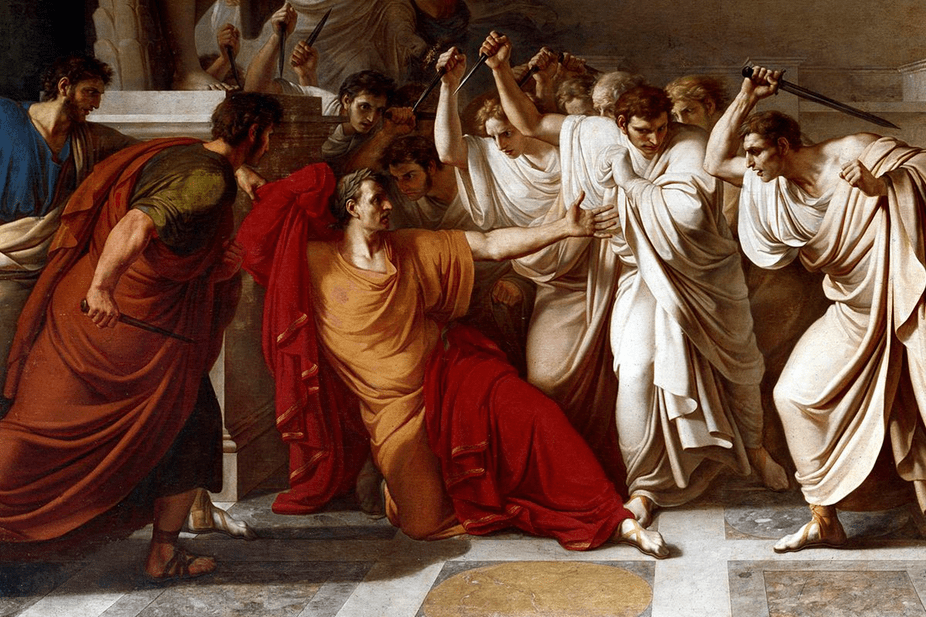
He already knew that in the Curia of Pompey‘s Theater fifteen or twenty people had stabbed Caesar to death; that the dictator was amazed at Brutus’s participation and even exclaimed, “And you, my child?” after which he covered his head with a toga and stopped resisting, resigning himself to fate; that Brutus was struck by this phrase, believing that it was a hint of paternity and that he had actually killed his tyrant father, as he once boasted.
The people, having learned about Caesar’s will to distribute three hundred sesterces to each citizen of Rome, attacked the conspirators. Tension was growing, Consul Mark Antony and his legionnaires began hunting for the rebels, people were preparing to smash and rob the houses of the senators who participated in the assassination attempt, and Pierre and his detachment went after Bart.
Bart, awakened and excited by the news coming via teleportation from Brutus, prepared to retreat to the Taurina until he was confronted by real Brutus. Bart had no doubt that he must act decisively, like Caesar, who, after doubts, moved his troops to Rome, crossed the Rubicon and said, “The die is cast!”
Historically, everything was simple with Portia: Brutus fled and, most likely, never met his wife. She, as promised, chose a painful death by swallowing hot coals. It was as if history itself gave the cadets the opportunity to carry out Operation Paradise, popular at the Temporal Academy. That is, replace the “corpse” of a historical person with a biodegradable dummy. Alas, the most difficult task was to persuade this person, in this case – Portia, to go with Bart. How to explain her where to? And that’s not even the point, but her love for her husband, which Bart is stealing…
The clatter of hooves and the neighing of horses could be heard in the street. This detachment of horsemen, led by Pierre and Titus, rode up to Brutus’s house.
“House of the praetor Marcus Junius Brutus? A check up! Open the gate, move away from the door!”
Several people dismounted and hurried to the house with swords at the ready, but the servants were not going to resist anyway and allowed the military into the chambers.
In the living room, where the fire was burning in the hearth, they were met by husband and wife – Marcus Junius and Portia. There were no freed-slaves – servants or slaves.
“All ours?” asked Portia.
“Yes mam!” Pierre reported.
“Have you brought the biodegradable dummy?”
“As was ordered,” Titus confirmed.
He made a gesture with his hand, and two tall legionnaires carried a large package into the living room.
Bart looked at the scene unfolding in front of him with eyes widened in surprise. “His” Portia commanded Pierre, Titus, legionnaires? It was hard to believe. The bag contained Portia’s mannequin, onto whose chest she threw a shovel full of hot coals from the fireplace.
“Put on your legionnaire uniform,” said Titus, “Let’s evacuate!”
“Stella is our colleague from the Temporal Academy, Bart,” added Pierre. “She replaced Portia, who died from a wound in her thigh, and in her thesis she tried to save Caesar by putting you to sleep and locking you in the bedroom.
“So that’s why I didn’t find a scar on your thigh, Stella. How glad I am that I met you and did not have to “kidnap” Portia from Brutus! ”
“Don’t worry. I sent a slave to the curia with the news that I was dying. No reaction! He is already all about politics. And I, like you, am glad that I met my hero. It’s easier to cross the Rubicon together.”
“Especially when the die has already been cast,” Bart smiled joyfully.
 Nick Neim's Stories